



Key Takeaways
- The standard gutter slope is a 1/4 inch drop per 10 linear feet of gutter run toward the downspout.
- Slope that is too shallow causes pooling; slope that is too steep causes overflow and erosion near the foundation.
- Mosquitoes need only a few days and a small amount of standing water to complete their breeding cycle.
- Clogged gutters can trap water even in a correctly pitched system, making regular cleaning just as important as proper installation.
- Sagging hangers and settling foundations quietly destroy good slope over time and need periodic professional inspection.
- Gutter slope of 1/4 inch per 10 linear feet is the industry standard for effective drainage toward the downspout.
- Too little slope causes pooling, algae growth, pest habitat, and accelerated corrosion; too much slope causes overflow and foundation erosion.
Why Gutter Slope Matters: The Foundation of Proper Drainage
Your gutters do one job: move rainwater off your roof and away from your home’s foundation as quickly as possible, according to common industry estimates from 2024. That job depends almost entirely on proper gutter slope mistakes, also called pitch in the $2,500, $6,000 range for mid-size projects. Without the right angle, water slows down, stops, and sits.
Understanding common gutter slope mistakes before problems appear is the most cost-effective way to protect your home.
Proper gutter pitch is the single most influential factor in whether a gutter system drains effectively or creates a persistent pooling problem.
How gravity and pitch angle work together to move water
Gutters are not pressurized pipes. They rely on gravity and a consistent downward angle to carry water from the far end of each run toward the nearest downspout. Even a small, deliberate drop in elevation keeps water moving at a pace that prevents sediment from settling and debris from damming the flow.
A level gutter, despite looking "correct" visually, will collect water at every low point along the run. Over time, that trapped water becomes a habitat problem, a rot problem, and a foundation problem all at once.
What happens when slope is too shallow or nonexistent
When the pitch drops below the recommended minimum, water velocity slows enough that it stops draining before the next rain event begins. You end up with a trough of stagnant water sitting exposed to sunlight and organic debris, the exact combination that breeds algae, mold, and insects.
According to signs of improper gutter slope mistakes documented by Gutter Doctor, one of the clearest warning signs is water leaking from the end of the gutter opposite the downspout, meaning the pitch is reversed and water is traveling the wrong direction entirely.
The connection between pooled water and mosquito breeding cycles
This is where a drainage problem becomes a health problem. Mosquitoes need as little as 1/2 inch of stagnant water to lay eggs, and larvae can develop into adults in as few as 7 to 10 days under warm conditions. Your gutters, sitting at roof height and largely out of sight, create the perfect sheltered breeding environment when they fail to drain.
Pest control experts note that clogged gutters are a primary mosquito breeding site that most homeowners overlook entirely because the problem is not visible from the ground. Capital Region summers give mosquitoes a long enough warm season to cycle through multiple generations if the water source is not eliminated.
The Correct Gutter Slope: Measurements and Installation Standards

gutter slope mistakes follows a straightforward standard that experienced installers apply to every run, regardless of gutter material or home style.
The widely accepted industry standard for gutter pitch is a drop of 1/4 inch for every 10 linear feet of gutter, measured from the high end of the run down toward the downspout.
Industry-standard pitch ratios and how to calculate them
A 40-foot gutter run needs a total drop of 1 inch from one end to the downspout (4 x 1/4 inch). A 20-foot run needs a 1/2 inch drop. The math is simple, but executing it during Gutter Installation requires snapping a precise chalk line along the fascia board before a single hanger is set.
In our experience, skipping that chalk line is where most field errors begin, regardless of how many jobs a crew has completed.
| Gutter Run Length | Minimum Drop (1/4" per 10 ft) | Approx. Visual Appearance |
|---|---|---|
| 10 ft | 1/4 inch | Nearly level to the eye |
| 20 ft | 1/2 inch | Subtle tilt, barely visible |
| 30 ft | 3/4 inch | Noticeable at close range |
| 40 ft | 1 inch | Visible slope from the ground |
| 60 ft | 1.5 inches | Clearly pitched; may need mid-run downspout |
For long runs over 40 feet, many installers pitch from the center of the run down toward two downspouts, one at each end. This prevents the low end of a very long run from looking dramatically dropped relative to the roofline.
Common measurement mistakes homeowners and contractors make
The most frequent gutter slope mistake is setting hangers by eye rather than by measurement. A gutter that looks level from the ground may actually have a slight reverse pitch, sending water away from the downspout. Other common errors include letting the fascia board dictate pitch when the fascia itself has settled unevenly, or failing to account for the weight of debris and water that will push hangers down over time.
Knowing how much should a rain gutter slope before hiring a contractor gives you better questions to ask during an estimate and helps you verify work after installation. If a contractor cannot explain their chalk-line method, that is a red flag worth taking seriously.
Common Gutter Slope Mistakes and Their Consequences
Slope too shallow: pooling, algae, and pest habitat
A pitch that is too gentle, anything less than 1/4 inch per 10 feet, leaves water sitting in the trough after rain stops. That shallow puddle quickly becomes discolored with algae growth, and the organic debris trapped with it creates a hospitable environment for mosquitoes, ants, and other insects. We’ve seen this pattern repeatedly on homes where gutters were installed level by a previous contractor who relied on visual judgment alone.
Consistently shallow-pitched gutters also accelerate corrosion. Aluminum and steel gutters are designed to shed water quickly, not hold it. Stagnant water accelerates gutter deterioration and shortens the useful life of the system by several years.
Slope too steep: overflow, erosion, and foundation damage
More slope is not always better. A pitch exceeding roughly 1/2 inch per 10 feet pushes water too fast toward the downspout, causing overflow at the outlet during heavy rain and potentially pulling the gutter lip away from the fascia under the weight of rushing water.
Sagging hangers and settling foundations that destroy proper pitch over time
Even a perfectly installed gutter will lose its slope if the hangers are spaced too far apart or begin to pull loose from aging fascia boards. Hanger spacing of no more than 3 feet apart is the general standard, and some installers go tighter in heavy snow regions like the Capital Region where ice and snow loads add significant stress to the system.
Homes naturally settle over years, and that settling shifts the fascia board, which shifts the gutter.
Blockages That Negate Good Slope: Debris, Leaves, and Sediment
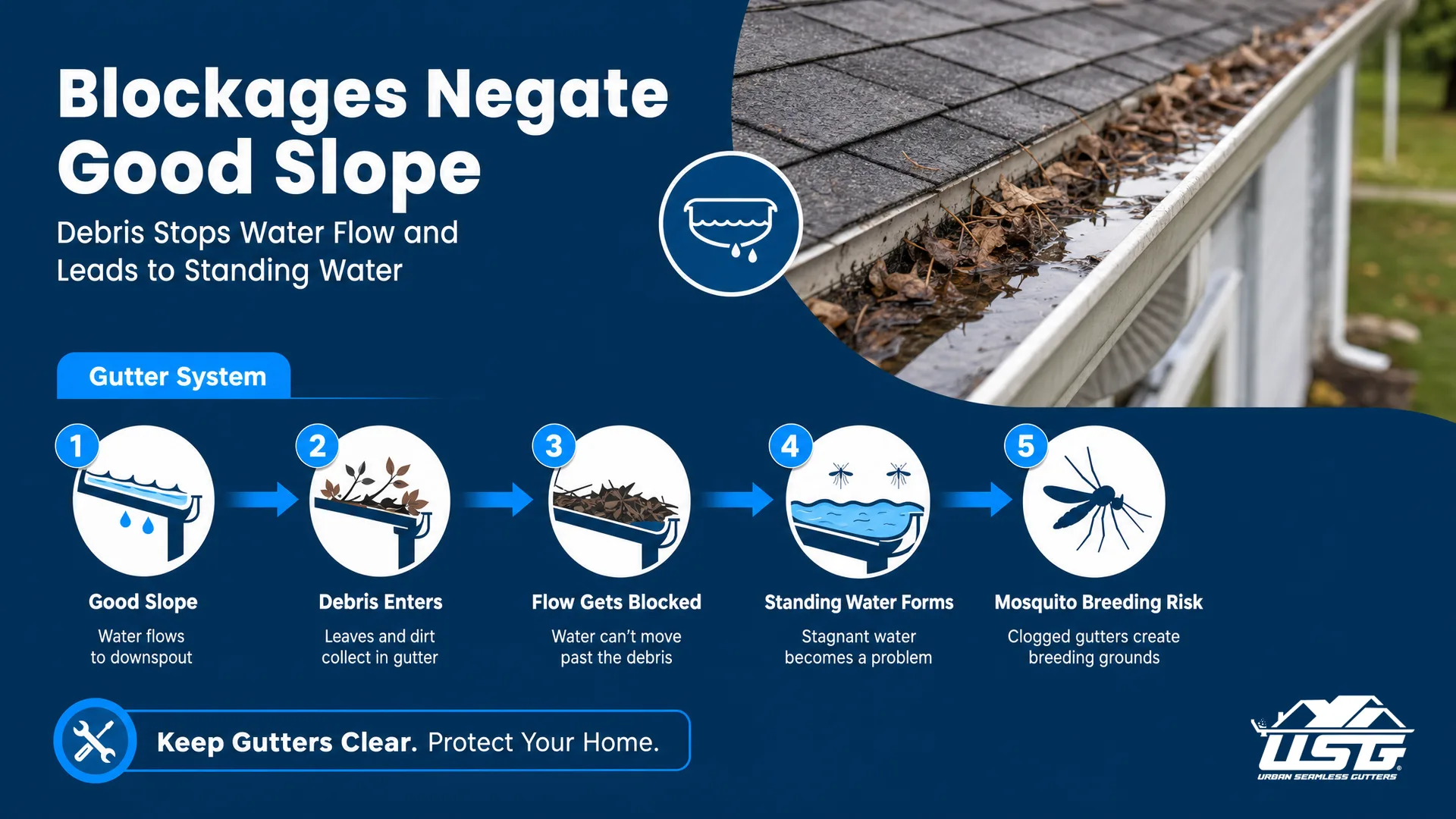
How blockages trap water even in correctly pitched gutters
A correctly sloped gutter can still hold pooled water if a debris dam forms anywhere between the high end of the run and the downspout.
This is why professional Gutter Cleaning services are a necessary companion to proper slope, not a substitute for it.
Seasonal debris patterns and maintenance schedules that prevent clogs
In Albany and the Capital Region, the two highest-risk seasons for gutter blockages are late October through November (heavy leaf fall) and March through April (post-winter debris and shingle grit washed down by snowmelt).
| Season | Primary Debris Type | Recommended Action |
|---|---|---|
| Late Spring | Pollen, seed pods, light grit | Optional light cleaning |
| Late Fall (Oct, Nov) | Heavy leaf accumulation | Full cleaning, critical |
| Early Spring (Mar, Apr) | Shingle granules, winter debris | Full cleaning, critical |
| Summer | Minimal unless storm-heavy | Spot check after major storms |
Homeowners who want to reduce how often they climb ladders should consider Micromesh Gutter Guards, which block the debris that causes most seasonal clogs without restricting water flow.
Diagnosing Standing Water in Your Gutters: Signs and Solutions
Visual inspection techniques and tools to measure slope and pooling
You do not need specialized equipment to diagnose a gutter slope problem.
For a closer look, a basic 4-foot level and tape measure confirm whether your pitch is in the right range.
When to adjust slope, clean, or replace gutters versus when to call a professional
Gutter Cleaning handles blockage-related pooling.
Those situations call for professional Gutter Repair or Gutter Replacement.
A good rule of thumb: if the same section pools after two consecutive cleanings, the pitch itself needs attention, not more cleaning.
Preventing Mosquito Breeding and Water Damage: Action Steps for 2026
Getting rid of pooled water in your gutters is not a one-time fix.

Immediate repairs to eliminate pooled water and mosquito habitat
If you already see water pooling or notice mosquitoes around your roofline, start here. Flush your gutters with a garden hose from the high end of each run toward the downspout.
Once the gutters are clear, check for water that remains after flushing.
This is straightforward work for a professional and worth doing correctly the first time, since improperly reset hangers will sag again within a season or two.
According to Mosquito Squad, eliminating the water source is far more effective than treating mosquitoes after they hatch.
Long-term maintenance and monitoring to keep gutters flowing year-round
Consistent maintenance is what keeps a correctly pitched system performing year after year.
Every two to three years, have a professional walk the roofline and verify that hangers are still holding pitch and that no sections have begun to sag.
Installing Gutter Guards, particularly Micromesh Gutter Guards that block fine debris without slowing water flow, dramatically reduces how often full cleanings are needed and lowers the chance of a debris dam forming between visits.
If your gutters are more than 20 years old or show repeated sagging, cracking, or separation at the seams, a full Gutter Replacement may be more cost-effective than continued repairs.
Frequently Asked Questions
How much should a gutter slope per foot?
The standard is a 1/4 inch drop for every 10 linear feet of gutter run.
How do I fix a gutter slope that is too flat?
Start by removing any debris and running water through the gutter to confirm the slope is the actual problem rather than a clog.
If the fascia board is soft or rotted, it needs to be repaired before the hangers will hold.
How do I know if my gutters are sloped correctly?
The simplest test is to run a garden hose at the high end of each gutter run during dry weather and watch whether water flows steadily toward the downspout or pools anywhere along the trough.
What are the most common gutter slope mistakes homeowners make?
The most common gutter slope mistakes include installing gutters level by eye instead of measuring pitch, failing to recheck hangers after a harsh winter, and ignoring early signs like mid-run drips or slow drainage.
Do gutter guards affect slope or drainage performance?
Gutter Guards do not change the pitch of your gutters, but they do affect how much debris reaches the trough and whether blockages form over time.
When installed over an incorrectly pitched system, they cannot compensate for a slope problem.
 Ready for a free quote? Share a few details with Urban Seamless Gutters, we’ll help you choose the right next step. Get a Free Quote |