



Key Takeaways
- Micromesh guards offer the best debris protection but cost more upfront than screen or foam options.
- Your local tree cover in areas like Albany, Clifton Park, or Saratoga Springs matters more than most homeowners expect when choosing a system.
- Professional installation typically outperforms DIY on seamless gutters because fit and slope alignment are critical.
- Ongoing maintenance costs vary widely by guard type, so total cost of ownership beats comparing sticker price alone.
- Always ask contractors about warranty terms and material compatibility before signing anything.
Why Gutter Guard Selection Matters for Long-Term Maintenance
The guard you install today determines how much maintenance your gutters need over the next decade. Choosing the wrong system doesn’t just mean extra cleaning. It can mean clogs, overflow, water intrusion, and expensive repairs to your foundation or fascia.
Impact on cleaning frequency and labor costs
A well-matched guard can cut your annual cleaning rain gutter visits from twice a year down to once every few years. A poorly matched one can actually trap debris inside the channel where it’s harder to reach. If you’re searching for rain gutter installation near me and planning to add guards at the same time, factor cleaning frequency into your total budget from day one.
Gutter guards don’t eliminate maintenance entirely, but the right system can reduce cleaning labor costs significantly over a five- to ten-year period.
Protection level against debris and clogs
Different guards stop different debris. Micromesh handles pine needles and small seed pods. Basic screens block larger leaves but let shingle grit and fine debris pass through and accumulate.
Foam inserts allow water in but also collect organic material inside the foam itself, which can become a breeding ground for mold and seedlings over time.
Home value and curb appeal considerations
Well-installed guards made from aluminum or stainless steel blend cleanly with most gutter profiles. Cheap plastic screens that sag or discolor can detract from your home’s appearance. In neighborhoods around Saratoga Springs and Clifton Park where curb appeal supports strong resale values, visible gutter hardware is worth a second thought.
Common Gutter Guard Systems Compared
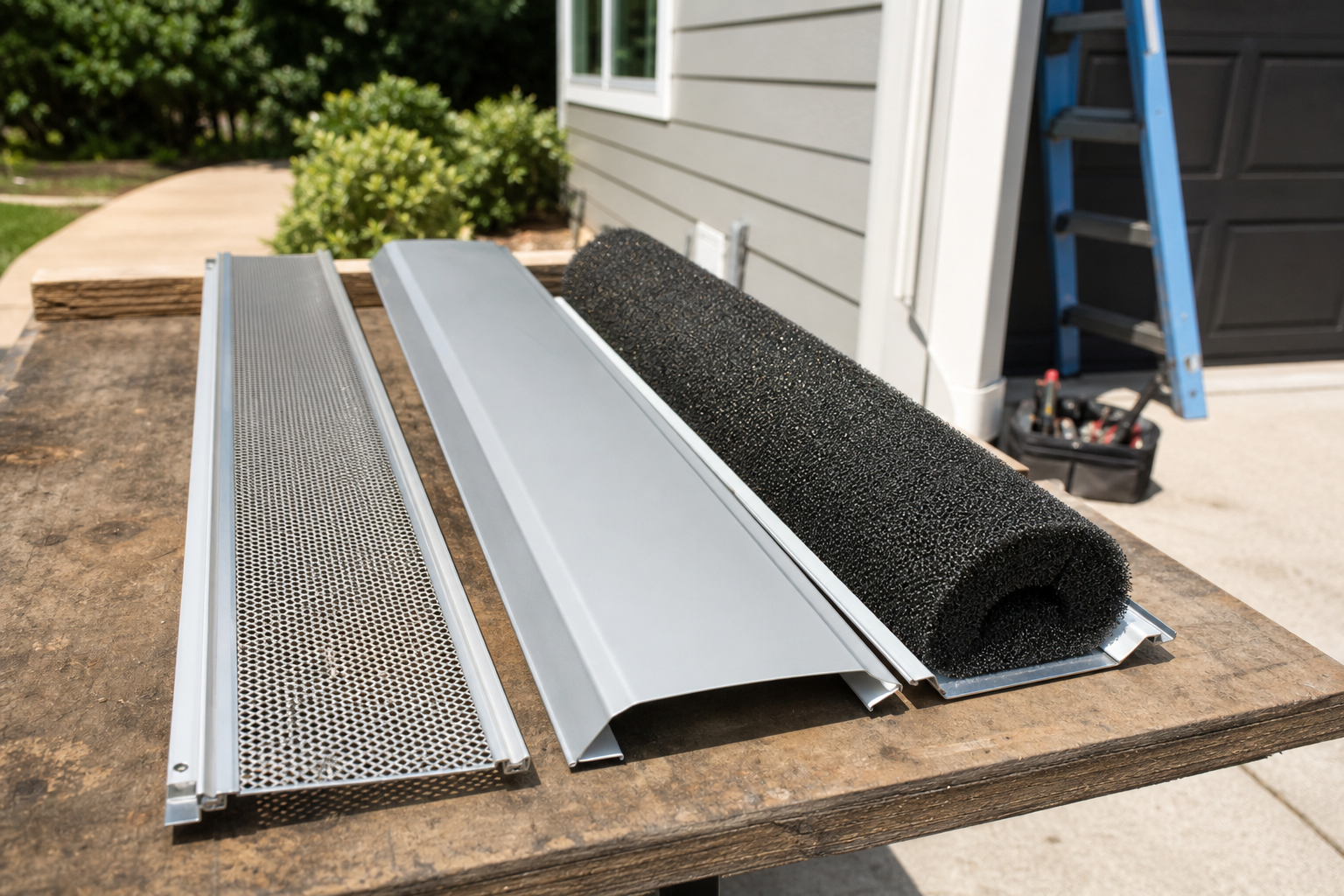
Not every guard works equally well in every setting. Here’s a straightforward breakdown of what’s available and where each type succeeds or falls short, which the gutter guard comparison resources at Leafguard also highlight in terms of design tradeoffs.
Mesh screens and their effectiveness
Mesh screens sit on top of the gutter opening and allow water through while blocking leaves and larger debris. Standard aluminum mesh screens are a step up from basic plastic inserts, but the quality of the mesh matters a great deal. Fine micromesh gutter guards, made from surgical-grade stainless steel, are the most effective screen-style option.
They block even pine needles and roof grit while maintaining strong water flow.
Solid covers and reverse-curve designs
Solid covers and reverse-curve (helmet-style) guards use surface tension to pull water around a curved edge into the gutter while debris falls off the front. They work well in heavy rain and leaf fall. The trade-off: in very heavy downpours, water can overshoot the channel entirely.
They also tend to be the most expensive option per linear foot and require precise installation to function correctly.
Foam inserts and brush-style guards
Foam and brush guards are the lowest-cost entry point. Foam inserts sit directly inside the gutter trough. Brush guards look like oversized pipe cleaners.
Both allow water through while theoretically blocking large debris. In practice, seeds, pine needles, and fine particles accumulate within the foam or brush bristles over time. These options require more frequent cleaning rain gutter maintenance than advertised, and they don’t hold up well through harsh upstate New York winters.
| Guard Type | Debris Blocked | Typical Lifespan | Maintenance Needed | Best For |
|---|---|---|---|---|
| Micromesh (stainless) | Pine needles, leaves, grit | 20+ years | Low (every 2-5 years) | Heavy tree cover |
| Solid cover / reverse-curve | Large leaves, twigs | 15-25 years | Low to moderate | Moderate tree cover |
| Aluminum mesh screen | Leaves, larger debris | 5-15 years | Moderate | Light tree cover |
| Foam insert | Large leaves only | 3-5 years | High | Minimal debris areas |
| Brush guard | Large leaves only | 3-5 years | High | Temporary or short-term |
Cost Analysis: Installation and Ongoing Expenses
Initial gutter guard installation costs by type
Guard costs vary widely. Foam and brush options are the cheapest upfront, typically running a few dollars per linear foot for materials. Aluminum mesh screens sit in a mid-range.
Micromesh and solid cover systems cost more per foot for both materials and professional installation, but they also deliver far lower maintenance costs over time. For a full breakdown of what to expect, the average cost of gutter installation is a helpful starting reference.
Maintenance and replacement expenses over time
A foam insert that costs less per foot upfront may need full replacement every 3-5 years. A professional micromesh installation, by contrast, may only need a quick rinse every few years. Over a ten-year window, the total cost of ownership for a quality micromesh or solid cover system usually comes out ahead of cheaper alternatives.
As guides like the one from Prime Gutter Works on hiring gutter installation companies point out, evaluating total cost of ownership rather than just installation price is one of the clearest signs of an informed buyer.
| Guard Type | Approx. Install Cost (per linear ft.) | Replacement Interval | 10-Year Total Cost Estimate |
|---|---|---|---|
| Foam insert | $2-$4 | 3-5 years | High |
| Brush guard | $3-$5 | 3-5 years | High |
| Aluminum mesh screen | $1-$3 + labor | 5-15 years | Moderate |
| Micromesh (stainless) | $15-$25 + labor | 20+ years | Low to moderate |
| Solid cover / reverse-curve | $15-$30 + labor | 15-25 years | Low to moderate |
Costs are approximate ranges. Your actual price depends on home size, linear footage, and local labor rates.
Key Factors to Evaluate for Your Home
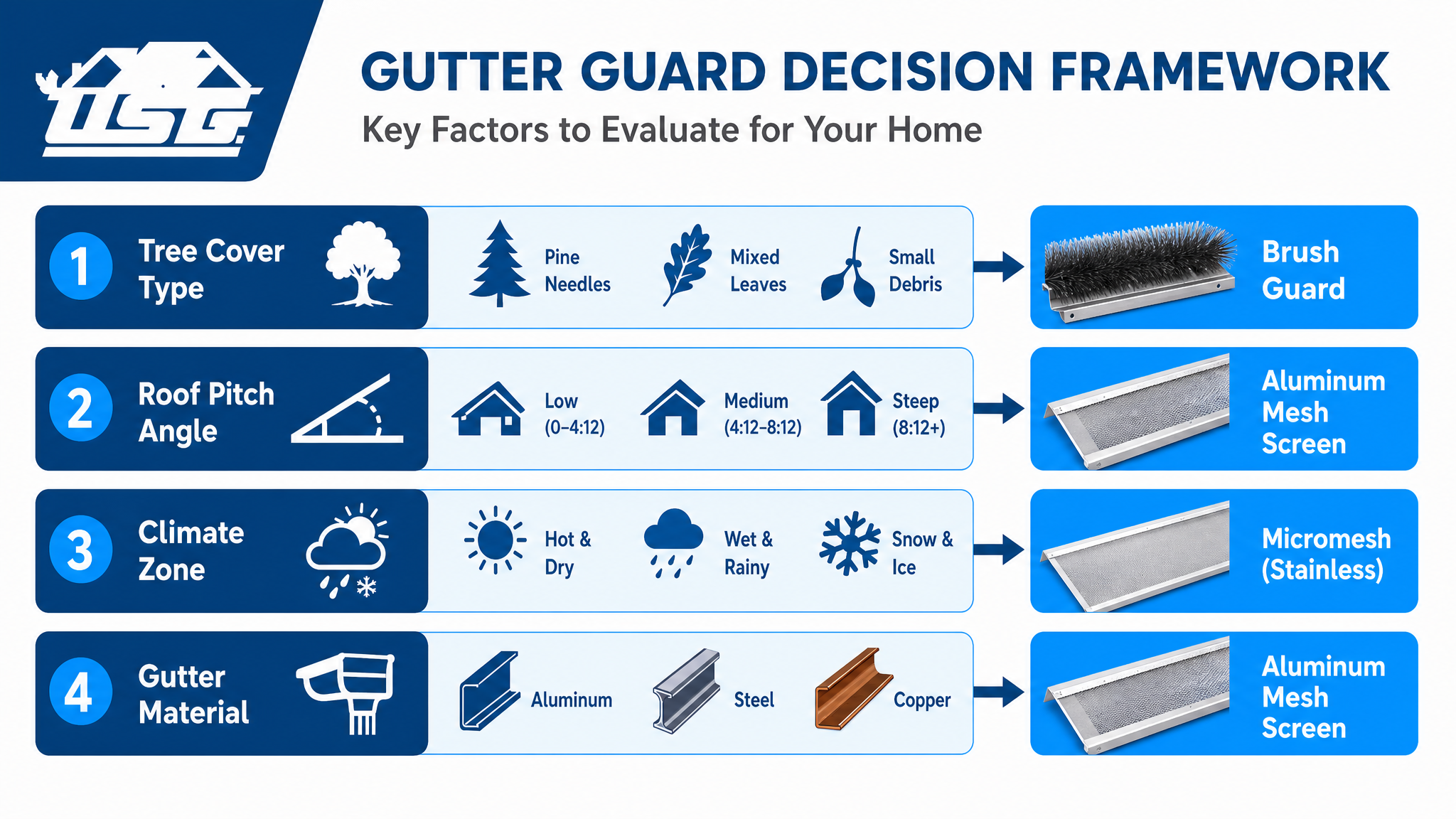
No two homes in the Capital Region face identical conditions. The right guard for a ranch-style house surrounded by maples in Schenectady may be completely different from what a steep-roof colonial near Albany needs.
Climate, tree cover, and local weather patterns
Upstate New York brings heavy leaf fall in autumn, ice and snow loads in winter, and wet springs that flush debris through gutters. If your yard has pine trees, standard mesh screens will clog faster than you’d expect. Micromesh handles conifer needles far better.
Heavy snow and ice also put physical stress on guards, so lightweight foam options are at higher risk of compression and damage.
Roof pitch and gutter accessibility
Steeper roof pitches increase water velocity into the gutter, which means a guard’s water intake capacity matters more. High-pitch roofs also make DIY guard installation riskier. If your roofline is complex or hard to access, professional installation is the practical choice.
You can review seamless gutter installation options for Capital Region homes to see how roofline complexity affects both installation and guard selection.
Existing gutter material and condition
Gutter guards won’t fix a gutter system that’s already failing. If your gutters are pulling away from the fascia, have visible rust spots, or leak at the seams, address those issues first. Adding guards on top of compromised gutters is a short-term fix that leads to bigger problems.
Our guide on when to repair, clean, add guards, or replace seamless gutters can help you figure out the right sequence.
Installation Requirements and Professional Expertise
Compatibility with existing gutters
Not every guard fits every gutter profile. Most micromesh gutter guards are designed to attach to the front lip of a standard K-style gutter. Round or half-round gutters require guards specifically made for that profile.
Confirm compatibility before purchasing. A mismatch in sizing or attachment style can create gaps that defeat the guard’s purpose entirely.
Professional installation versus DIY feasibility
Simple snap-on mesh screens are genuinely DIY-friendly if your gutters are accessible and in good shape. More advanced systems, including solid covers and precision micromesh installations, require experience. Incorrect pitch alignment, gaps at mitered corners, and improper fastening can all reduce performance significantly.
For most homeowners searching for rain gutter installation companies near me, professional installation delivers a better outcome and often comes with a warranty that DIY work cannot.
As Gutter Shutter’s contractor selection guide notes, working with a local contractor who knows your region’s specific weather patterns and roof styles tends to produce more reliable results than national franchise installations.
Making Your Decision and Next Steps
Questions to ask contractors before committing
Before you approve any guard installation, ask these directly:
- What guard material and brand are you recommending, and why for my specific home?
- How does this system handle pine needles and roof grit?
- Who is responsible if the guard causes water overflow or gutter damage?
- Will this void my existing gutter warranty?
- Do you handle gutter cleaning if the guard needs maintenance down the road?
Warranty and guarantee options to compare
Quality guard systems from reputable manufacturers carry product warranties of 15-25 years or more. That warranty is only valuable if the installer stands behind their work. Ask for a written installation warranty in addition to the manufacturer’s product warranty.
A company that offers a follow-up service or maintenance check in the first year gives you an important extra layer of protection.
Frequently Asked Questions
Do gutter guards eliminate the need for cleaning rain gutters?
No guard system is completely maintenance-free. Cleaning rain gutter channels periodically is still necessary even with the best micromesh systems. What a quality guard does is extend the time between cleanings significantly, often from twice a year down to once every two to four years depending on your tree cover and debris load.
Which gutter guard type works best in upstate New York winters?
Rigid systems, specifically aluminum micromesh and solid cover guards, handle snow and ice loading far better than foam or brush inserts. Foam compresses under heavy snow and rarely returns to its original shape. Stainless micromesh maintains its structure through freeze-thaw cycles, which is particularly important in Albany, Schenectady, and Saratoga Springs where temperatures swing dramatically from October through March.
How do I know if my existing gutters are compatible with gutter guards?
The most reliable way is to have a professional assess your gutters before purchasing any product. Key factors include gutter profile (K-style versus half-round), width, front lip height, and overall structural condition. Guards installed on gutters that are already sagging or pulling away from the fascia will not perform correctly.
If your gutters need repair first, our gutter repair services page explains what to expect before guard installation begins.
Is professional installation worth the extra cost for gutter guards?
For most homeowners, yes. Snap-on screen products can be a reasonable DIY weekend project if your gutters are in good shape and your roofline is simple. But micromesh and solid cover systems require precise alignment at every corner, joint, and downspout transition.
An incorrect fit creates gaps that let debris in or causes water to overshoot the channel. Professional installation also typically comes with a warranty that DIY work does not.
How many years should a quality gutter guard system last?
That depends on the material. Stainless steel micromesh and aluminum solid covers are designed to last 20 years or more with minimal maintenance. Mid-grade aluminum screen products typically last 5 to 15 years before needing replacement or repair.
Foam and brush guards are the shortest-lived options at roughly 3 to 5 years, making them a poor long-term investment despite their lower upfront cost.
 Ready for a free quote? Share a few details with Urban Seamless Gutters, we’ll help you choose the right next step. Get a Free Quote |