



Key Takeaways
- Overhanging branches cause debris clogs, physical sagging, and trapped moisture that accelerate gutter failure.
- Early warning signs include visible blockages, water spilling over gutter edges, and gaps at the fascia.
- Secondary damage to fascia boards, soffits, and roofing can multiply repair costs well beyond the gutters themselves.
- Trimming branches back at least 10 feet from your roofline is the most effective prevention.
- Micromesh gutter guards significantly reduce debris accumulation between cleaning visits.
How Overhanging Branches Damage Gutters
Overhanging branches damage gutters in three primary ways: constant debris accumulation that causes clogs, physical weight and friction that bend and pull the system away from the fascia, and trapped moisture that corrodes metal over time.
Albany sits inside a corridor of mature hardwoods and softwoods. Oaks, maples, and white pines are beautiful, but they shed year-round. When branches extend over your roofline, every season brings a new wave of material into your gutters.
Debris Buildup and Clogs
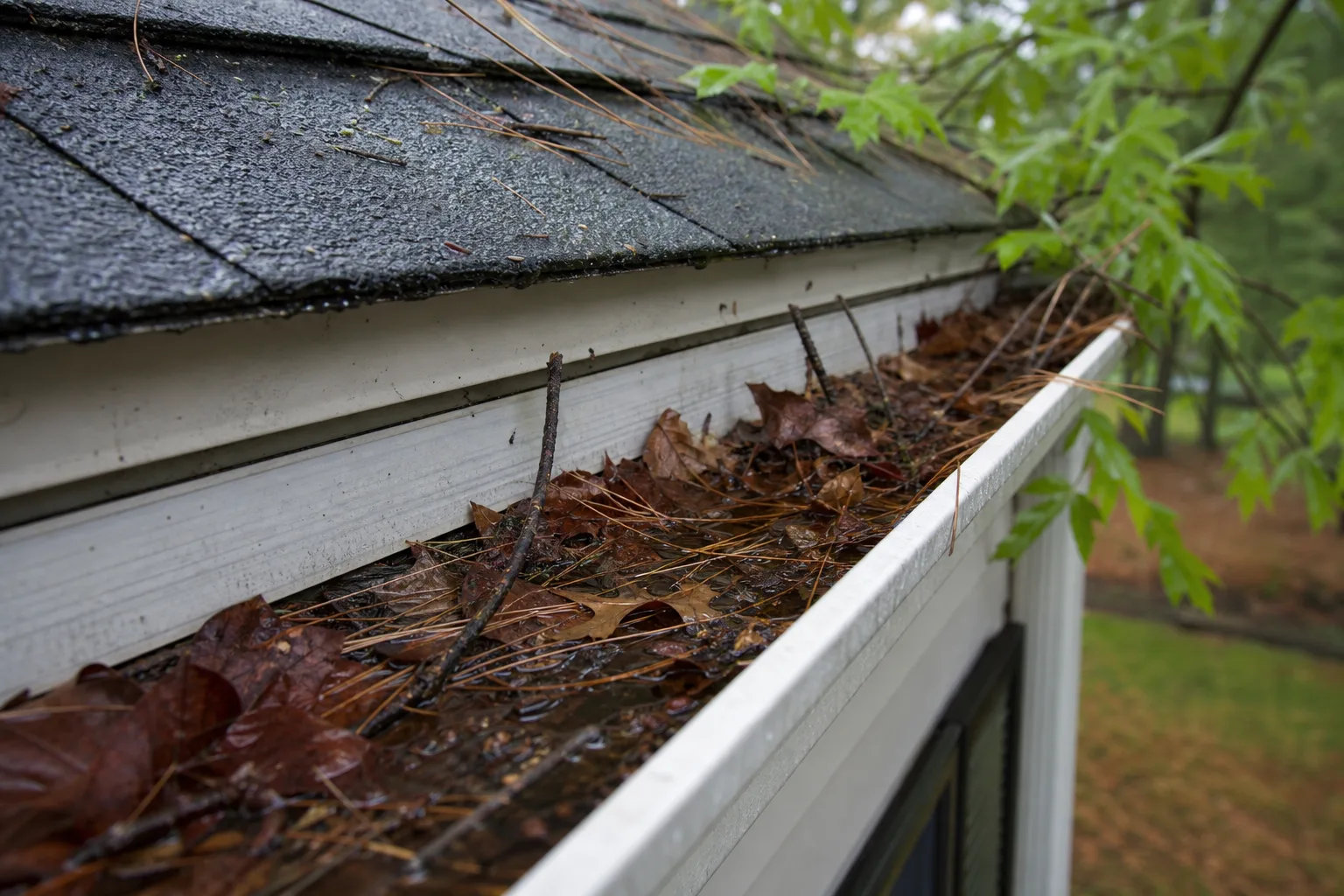
Leaves are the obvious culprit, but the real damage comes from what follows. Twigs, seed pods, and pine needles compact into a dense mat that water cannot penetrate. That standing water has nowhere to go except over the edge or backward under your shingles.
As noted in guides covering common types of tree damage to gutters, downspout clogs from tree debris are one of the most frequent service calls gutter professionals handle. In Albany, the fall leaf drop combined with spring pine needle shed means gutters can fill up faster than most homeowners expect.
Physical Weight and Sagging
A soaking wet pile of leaves and sticks weighs a surprising amount. Seamless aluminum gutters are designed to carry water, not compressed organic material. Over a single wet season, that extra load bends the gutter channel, pulls mounting brackets loose, and causes the whole run to sag away from the house.
Beyond debris weight, low-hanging branches can physically scrape or press down on the gutter during wind events. A branch that rubs the same spot repeatedly will eventually dent, crack, or push the gutter off its slope, which ruins proper drainage entirely.
Moisture Retention and Rust
Compacted debris holds moisture against the metal like a wet sponge. For steel gutters, that means rust. For aluminum, it means accelerated oxidation and joint failure.
Shaded gutters under heavy tree canopy dry out much more slowly after rain, giving corrosion more time to work.
Signs Your Gutters Are Being Damaged by Trees
Catching tree damage early keeps repair costs manageable. The signs are usually visible if you know where to look.
Visible Debris and Blockages
Walk around your home after a heavy rain and look up. If you see leaves and sticks piled in the gutter channel, dark staining down the siding below a gutter seam, or standing water still sitting in the trough an hour after the rain stops, debris has created a problem. Gutters clogged by tree material often show a distinct green or dark brown stripe along the front lip where water overflows repeatedly.
Water Overflow and Foundation Issues
Overflowing gutters are more than an eyesore. That water lands at the base of your foundation, saturates the soil, and over time creates hydrostatic pressure against your basement walls. Albany homeowners dealing with basement dampness often trace the root cause back to clogged or damaged gutters rather than a structural waterproofing issue.
If you notice consistent wet spots in your basement or crawl space after rainstorms, your first call should be to inspect the gutters above those areas. Our gutter cleaning services can identify and clear blockages before foundation damage compounds the problem.
Gutter Separation and Misalignment
Gutters that have pulled away from the fascia, developed visible dips, or show gaps at the end caps are showing the effects of long-term physical stress. This kind of misalignment is rarely caused by one storm. It usually results from months of accumulated weight and repeated impacts from branches.
If you spot gaps between the gutter and roofline or water dripping from joints that were previously sealed, it is time for a professional inspection. Our gutter repair services address both the symptom and the underlying cause.
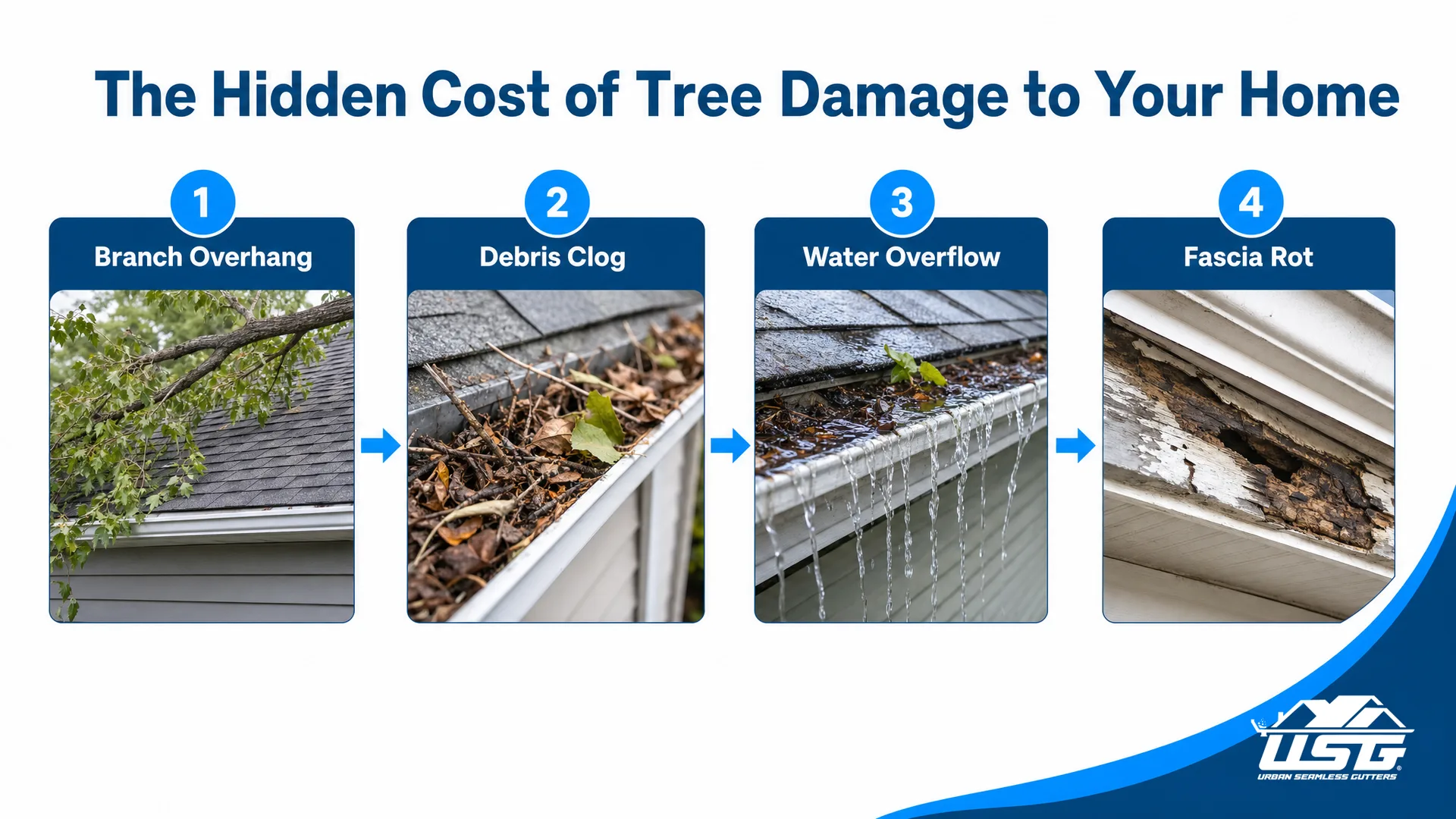
The Hidden Cost of Tree Damage to Your Home
Most homeowners underestimate how quickly gutter damage spreads to other parts of the structure.
Gutter Replacement and Repair Expenses
A basic gutter repair, like resealing a joint or rehinging a sagging section, is a relatively small expense. But when debris damage or branch impact goes ignored for a full season, the system often deteriorates to the point where gutter replacement becomes the only practical option.
Understanding the full picture before you get a repair quote helps. The average cost of gutter installation varies based on linear footage, material, and the complexity of your roofline, but a full replacement is always more expensive than timely maintenance.
Secondary Damage to Fascia, Soffit, and Roof
Gutters that overflow or leak at the back edge direct water onto the fascia board, which is typically untreated wood. Once that board softens, the gutter has nothing solid to anchor to, and the entire run becomes unstable. Soffit panels below a leaking gutter absorb water through ventilation gaps, which creates conditions for mold growth inside your eave structure.
| Damage Type | Typical Cause | Estimated Repair Scope |
|---|---|---|
| Clogged downspouts | Leaf and debris accumulation | Minor (cleaning or flush) |
| Sagging gutter run | Debris weight, bracket failure | Moderate (rehang or partial replace) |
| Fascia board rot | Chronic back-edge overflow | Moderate to major (carpentry + gutter) |
| Soffit mold or damage | Trapped moisture under eaves | Major (soffit replacement + remediation) |
| Full gutter system failure | Ignored damage over multiple seasons | Major (full replacement) |
Preventive Steps to Protect Your Gutters
Prevention is almost always cheaper than repair. The good news is that the steps are straightforward.
Trimming Branches and Managing Tree Growth
The single most effective thing you can do is keep branches trimmed back at least 10 feet from your roofline. This reduces falling debris, eliminates direct physical contact during windstorms, and allows sunlight to dry out your roof deck and gutters after rain.
For most homeowners, trimming branches that overhang a second-story roofline is not a DIY project. A certified arborist can assess which limbs pose the greatest risk and remove them safely. If you are unsure who is responsible for cutting overhanging tree branches that extend from a neighbor’s property, the general rule in New York is that you have the right to trim branches up to the property line, but ownership of the tree and liability for damage can vary.
For shared trees near the property boundary, a conversation with your neighbor (and possibly a local arborist) is the cleanest path forward.
Installing Gutter Guards and Protection Systems
Even well-trimmed trees drop debris year-round. Micromesh gutter guards are the most effective protection system available because the fine mesh blocks pine needles, seeds, and small particles while still allowing full water flow. Standard screen guards handle large leaves but let smaller debris through, which eventually compacts on top of or beneath the mesh.
Our step-by-step gutter guard installation guide for Capital Region homeowners walks through what to expect from a professional installation, including which guard systems perform best in Albany’s mix of hardwood and softwood debris.
Scheduling Regular Gutter Cleaning and Inspections
Even with guards installed, gutters should be cleaned and inspected at least twice a year: once in late spring after tree seeds and flowering debris have dropped, and again in late fall after the leaves are down. Homes directly under heavy tree canopy often need a third visit in mid-summer when fine organic material accumulates fastest.
When to Call a Professional for Gutter Repair
Some problems are easy to spot. Others hide until a rainstorm reveals them. Here is a practical guide.
Professional Tree Trimming and Removal Services
If a branch is large enough that removing it requires climbing more than 10 feet, cutting near a power line, or working within reach of your roofline, call a licensed arborist. Dropping a heavy limb onto a gutter run can destroy an entire section in seconds. The cost of proper tree work is far lower than the cost of emergency gutter repair combined with potential roof damage.
Gutter Replacement and Reinforcement Solutions
When a gutter system has sagged, separated, or corroded to the point where repairs would only delay replacement, a full seamless gutter installation is the right answer. Seamless aluminum gutters custom-fabricated on site have no mid-run joints, which means fewer leak points and better resistance to the kind of long-term stress that overhanging branches create.
| WARNING SIGN | RECOMMENDED ACTION |
|---|---|
| Gutters pulling away from fascia | Rehang and reinforce bracket spacing |
| Visible sagging or dips in the run | Assess slope and rehang or replace affected section |
| Rust stains or corrosion streaks | Clean, treat, and evaluate remaining lifespan |
| Joints leaking after resealing | Replace affected section with seamless run |
| Full system misalignment | Full seamless gutter replacement |
| Warning Sign | Recommended Action |
If you are unsure whether your system needs repair or full replacement, a free estimate from a local professional takes the guesswork out of the decision. Our team serves Albany, Schenectady, Clifton Park, and Saratoga Springs, so the answer is usually just a phone call away.
Next Steps for Albany Homeowners
Tree damage to gutters is a slow, compounding problem. The branches do not cause visible destruction overnight. They work gradually, season by season, filling your gutters with debris, bending the channel under accumulated weight, and trapping moisture against the metal and wood until the system fails.
By the time most homeowners notice the damage, it has already spread beyond the gutters themselves.
The smartest move is to inspect your gutters now, before the next heavy rain or windstorm. Walk the perimeter of your home and look for the warning signs described above: debris-packed channels, water stains on siding, gaps at the fascia, or any visible sagging. If trees overhang your roofline by more than a few feet, add branch trimming to your fall maintenance list alongside your gutter cleaning appointment.
Albany homeowners can also check our guide on when to repair, clean, add guards, or replace seamless gutters to get a clearer sense of which service fits your situation before calling. Having that context makes the conversation faster and the estimate more accurate.
Frequently Asked Questions
Who is responsible for cutting overhanging tree branches?
In New York, the general legal principle is that a property owner has the right to trim branches and roots that encroach onto their property, up to the property line, at their own expense. However, ownership of the tree is typically determined by where the trunk sits. If the trunk is entirely on your neighbor’s land, the tree belongs to them, and responsibility for major removal or hazardous limb work can be a shared or disputed question depending on circumstances.
If a neighbor’s tree drops a limb that damages your gutters, New York courts have generally held that liability depends on whether the tree owner knew or should have known the tree posed a hazard. Documenting visible dead or overhanging branches and notifying your neighbor in writing is the safest approach before any dispute reaches that level.
Can you cut overhanging branches from a neighbor’s tree yourself?
You can legally trim branches that cross onto your property up to the property line, but there are important limits. You cannot enter your neighbor’s property to do the work without permission, and you cannot cut branches in a way that kills or severely damages the tree. Doing so could expose you to liability for the value of the tree.
For branches that extend over your roofline and directly threaten your gutters, the practical path is to document the issue, speak with your neighbor, and if necessary, hire a licensed arborist to perform the work on your side of the line safely and legally.
How often should I clean my gutters if I have trees nearby?
Homes directly under or adjacent to mature trees should schedule professional gutter cleaning at least twice a year, typically in late spring and late fall. If your property has heavy pine coverage or is surrounded by multiple large hardwoods, a mid-summer visit is worth adding. Pine needles and seed pods accumulate quickly and compact into dense mats that are harder to clear the longer they sit.
Our gutter cleaning services are designed specifically for Capital Region homes, where the mix of deciduous and conifer debris creates year-round accumulation patterns that differ from warmer climates.
Do gutter guards eliminate tree debris problems completely?
Micromesh gutter guards dramatically reduce the volume of debris that enters your gutter channel, but no guard system eliminates maintenance entirely. Fine organic material like pollen, roof grit, and decomposed leaf particles can accumulate on top of the mesh over time. The advantage is that cleaning frequency drops significantly, and the risk of major clogs is far lower than with unprotected gutters.
According to research on tree damage to gutters, gutter covers are consistently recommended as a long-term protection strategy for homes near heavy tree canopy, precisely because they reduce the labor and cost of ongoing maintenance while protecting the system from the debris that causes the most damage.
What type of gutter material holds up best under tree canopy?
Seamless aluminum gutters are the most practical choice for Albany homes with significant tree coverage. Aluminum does not rust, it handles Albany’s freeze-thaw cycles well, and seamless fabrication eliminates the mid-run joints that are most vulnerable to debris-driven leaks. Steel gutters offer more structural rigidity but are more susceptible to rust when moisture is consistently trapped by leaf debris.
Copper gutters are exceptionally durable but carry a premium price that is difficult to justify purely on the basis of tree proximity. For most homeowners, seamless aluminum paired with a quality micromesh guard system is the highest-value combination.
How do I know if my gutter damage is severe enough to need full replacement?
The clearest indicators are structural: gutters that have pulled away from the fascia along multiple sections, visible sagging that cannot be corrected by rehanging, rust holes or cracks in the channel, or fascia boards that have softened and can no longer hold a fastener. If your gutters are more than 15 to 20 years old and show any of these signs, replacement is almost always more cost-effective than repeated repairs.
Our team can walk through the condition of your system during a free estimate and give you an honest assessment of whether repair or replacement makes more sense for your home. There is no obligation, and the inspection itself often reveals secondary issues that are far cheaper to address early.
 Ready for a free quote? Share a few details with Urban Seamless Gutters, we’ll help you choose the right next step. Get a Free Quote |