



If you’re deciding between seamless vs sectional gutters, you’re asking one of the most practical questions a homeowner can ask before a gutter project. The choice affects how long your gutters last, how often you’ll need repairs, and what you’ll spend over time. For homeowners in Albany, Schenectady, Clifton Park, and Saratoga Springs, where ice dams, heavy snowfall, and spring rainfall put real stress on drainage systems, the decision matters even more.
This guide breaks down both options clearly so you can make a confident, informed choice before committing to an installation or replacement.
Key Takeaways
- Seamless gutters are custom-cut on-site and have fewer joints, which dramatically reduces the risk of leaks.
- Sectional gutters come in pre-cut lengths joined together, making them easier for DIY installation but more prone to leaks over time.
- For most Capital Region homeowners, seamless gutter installation offers better long-term value despite a slightly higher upfront cost.
- Sectional gutters may suit rental properties or short-term budgets where upfront cost is the top priority.
- Professional installation is recommended for either type to ensure proper slope, drainage, and fastening.
- com), industry guidance aligns with these recommendations.
Quick Overview of Seamless vs Sectional Gutters: Which Options Exist
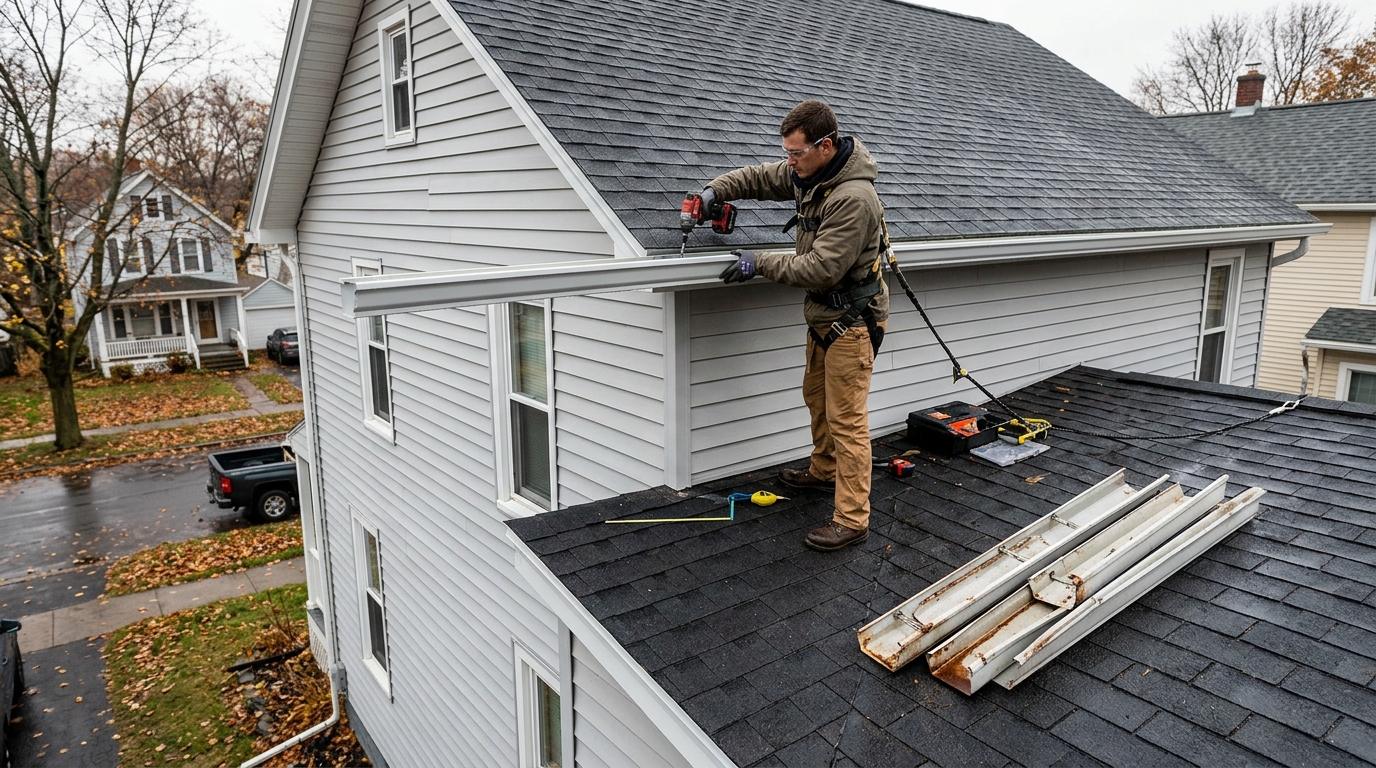
Seamless gutters are fabricated in one continuous piece custom-fit to each home, while sectional gutters are assembled from pre-cut lengths joined at seams. The key practical difference is that fewer seams means fewer places for leaks to develop.
Understanding the basic structure of each type helps you evaluate what fits your home, your budget, and your maintenance tolerance.
Who Each Option Is For
Seamless gutters are the right fit for homeowners who want a long-term, low-maintenance drainage solution. They’re ideal for homes with complex rooflines, for properties in areas with heavy rainfall or snow accumulation, and for anyone who doesn’t want to deal with frequent repairs. Sectional gutters appeal to homeowners working within a tight upfront budget, landlords managing rental properties, or situations where a quick, partial replacement is needed. They’re also the typical choice for experienced DIYers who want to handle installation themselves, since the sections are sold at home improvement stores.
Key Differences at a Glance
| Feature | Seamless Gutters | Sectional Gutters |
|---|---|---|
| Construction | Custom-cut on-site, one continuous piece | Pre-cut lengths joined at seams |
| Leak risk | Low (seams only at corners/downspouts) | Higher (seam at every joint) |
| Installation | Professional only | DIY possible |
| Upfront cost | Moderate to higher | Lower |
| Lifespan (typical) | 20+ years with maintenance | 10-20 years |
| Maintenance frequency | Lower | Higher |
| Curb appeal | Clean, tailored look | Visible seam lines |
| Common materials | Aluminum, copper, steel | Aluminum, vinyl, steel |
Side-by-Side Comparison
Both gutter types can protect your home when properly installed, but they behave differently over time. The differences become most visible after the first few winters.
Performance and Durability
Seamless gutters hold up significantly better in climates like Albany’s, where freeze-thaw cycles are common from November through March. Because there are no mid-run seams, there’s no place for ice expansion to pry joints apart. Water flows without obstruction from roof edge to downspout.
Sectional gutters develop their biggest weakness right at those joints. Over time, caulking degrades, metal expands and contracts, and sealant fails. Each seam becomes a potential drip point that, if ignored, can direct water against your fascia, soffits, and foundation.
According to the K-Guard Leaf Free Gutter System resource library, joint failure is among the most common reasons homeowners call for gutter repairs within the first five years. For an in-depth look at how proper installation protects your home year-round, the rain gutter installation guide for Albany and Capital Region homes walks through material choices, slope requirements, and local drainage considerations.
Cost and Maintenance Tradeoffs
Seamless gutter installation cost runs higher upfront than sectional gutters, primarily because fabrication requires a portable roll-forming machine brought to your property and the work must be done by a trained installer. Typical installed costs for aluminum seamless gutters range from roughly $6 to $12 per linear foot, while sectional aluminum gutters in comparable materials often run $3 to $8 per linear foot installed. That gap narrows quickly when you factor in maintenance.
Sectional gutters need periodic resealing at every joint, and a single leak ignored for one season can cause wood rot on fascia boards, a repair that costs far more than the price difference. For a detailed breakdown of what drives gutter pricing, see the average cost of gutter installation page.
Pros and Cons of Each Approach
Neither option is universally perfect. The right choice depends on your home, your goals, and how long you plan to stay in the property.
Best-Fit Scenarios
Choose seamless gutters when:
- You own your home and plan to stay for more than five years.
- Your home has multiple roof sections, valleys, or angles where sectional joints would multiply leak risks.
- You want to minimize annual maintenance and resealing work.
- You’re combining gutters with gutter guards for a fully protected drainage system.
- Your home is in a neighborhood where curb appeal affects resale value.
Choose sectional gutters when:
- You’re working with a strict short-term budget and plan to replace within a decade.
- You’re managing a rental property where upfront cost matters most.
- You need a partial repair or section replacement and matching existing gutters is the priority.
Limitations to Know Upfront
Seamless gutters require professional installation every time, including replacements. You cannot buy them at a hardware store and cut them yourself. That means scheduling availability and labor costs are always part of the equation.
Sectional gutters, while DIY-friendly, demand consistent maintenance. If you skip annual inspections, those joints will fail quietly until visible water damage appears inside your walls or along your foundation. Homeowners who choose sectional systems should budget time or money for professional gutter cleaning services at least twice a year to keep debris from adding weight stress at the seams.
How to Choose the Right Option
The right gutter type for your home comes down to three factors: how long you plan to stay, how much maintenance you’re willing to do, and what your roof’s geometry looks like. Use the checklist and questions below to clarify your decision.
Decision Checklist
Use this checklist before you request a quote:
- [ ] Do you own the home and plan to stay more than 5 years? (Favors seamless)
- [ ] Does your roof have multiple angles, dormers, or valleys? (Favors seamless)
- [ ] Is upfront cost your primary constraint right now? (May favor sectional)
- [ ] Are you adding gutter guards at the same time? (Strongly favors seamless)
- [ ] Does your neighborhood have HOA or aesthetic standards? (Favors seamless)
- [ ] Are you replacing gutters on a rental or investment property? (Evaluate sectional)
- [ ] Have your current gutters leaked at joints? (Clear signal to switch to seamless)
Questions to Ask Before Buying
Before committing to either option, ask these questions when speaking with a contractor:
- What material do you recommend for my roof pitch and local rainfall?
- How many downspouts are planned, and are they sized for my square footage?
- What is the expected lifespan under normal Capital Region weather conditions?
- What warranty covers both materials and labor?
- How will the gutters be fastened, and does the fascia need any repair first?
These questions help you evaluate contractor knowledge and set clear expectations. You can learn more about what a quality installation looks like in the seamless gutter installation step-by-step guide for Capital Region homeowners.
Conclusion and Recommendation
For most homeowners in Albany and the Capital Region, seamless gutters are the stronger long-term choice. They last longer, require less maintenance, and perform better under the freeze-thaw stress that defines winters in this region. The upfront cost difference is real but typically recoverable within a few years when you account for avoided repairs and resealing.
Sectional gutters remain a practical option for specific situations, particularly when short-term budget constraints are non-negotiable or when a partial replacement is the only scope at hand.
Summary Table
| Decision Factor | Seamless Gutters | Sectional Gutters |
|---|---|---|
| Best for long-term ownership | Yes | Less ideal |
| Better for Albany winters | Yes | Risk at joints |
| Lower upfront cost | No | Yes |
| Lower lifetime maintenance cost | Yes | No |
| DIY-installable | No | Yes |
| Best paired with gutter guards | Yes | Possible but less effective |
| Typical lifespan | 20+ years | 10-20 years |
Next Steps
If you’re ready to move forward, start with a professional assessment of your current system. A qualified contractor can measure your roofline, evaluate fascia condition, and recommend the right material and style for your specific home. Contact Urban Seamless Gutters for a professional assessment and a free estimate on seamless gutter installation, repair, or replacement across Albany, Schenectady, Clifton Park, and Saratoga Springs.
Frequently Asked Questions
Top Reader Questions
How long do seamless gutters last compared to sectional gutters?
Seamless gutters typically last 20 or more years with basic maintenance, such as annual cleaning and occasional downspout checks. Sectional gutters have a shorter practical lifespan, often 10 to 20 years, depending on how consistently the joints are resealed and inspected. In Albany’s climate, the gap tends to be on the wider end because freeze-thaw cycles accelerate joint failure in sectional systems.
Can I install seamless gutters myself?
No. Seamless gutters are fabricated on-site using a portable roll-forming machine that cuts continuous aluminum (or other metal) to the exact length of each run. That equipment is not available for consumer purchase or rental.
Installation always requires a professional. Sectional gutters, by contrast, are sold in pre-cut sections at home improvement stores and can be installed by skilled DIYers, though professional installation is still recommended for best results.
Is seamless gutter installation cost worth the premium over sectional?
For most homeowners, yes. The seamless gutter installation cost premium over sectional gutters typically ranges from $2 to $5 per linear foot, depending on material and region. However, seamless gutters require far less maintenance over time, and avoiding even one fascia or foundation repair can offset that difference entirely.
Over a 15-20 year ownership window, seamless systems almost always cost less in total. See the average cost of gutter installation page for a full cost breakdown by material and region.
Are sectional gutters a bad choice?
Not necessarily. Sectional gutters are a practical, widely used option that can protect your home effectively when properly maintained. Their main weakness is the seams, which require periodic inspection and resealing.
If you stay on top of that maintenance, sectional gutters can serve a home well for a decade or more. They become a poor choice when maintenance is neglected or when the home has a complex roofline with many corners and angles that multiply the number of joints.
What materials are available for seamless gutters?
Aluminum is the most common material for seamless gutters because it is lightweight, rust-resistant, and cost-effective. Copper is a premium option that develops a distinctive patina over time and can last 50 or more years with minimal maintenance, though the cost is significantly higher. Steel offers added strength for homes in areas with heavy debris loads or extreme weather. Vinyl is not typically used for seamless systems because it cannot be roll-formed on-site the same way metal can. For a closer look at material options and what suits Capital Region homes, the expert gutter installation services page covers the details.
How do I know if my existing gutters are seamless or sectional?
The easiest way is to look for visible seams along the horizontal runs of your gutters. If you see joints or overlapping sections every 10 to 12 feet, those are sectional gutters. Seamless gutters will appear as one continuous piece from corner to downspout, with connections only at the corners and where downspouts attach.
If you’re unsure or your gutters are showing signs of leaking, sagging, or pulling away from the fascia, it’s worth having a professional evaluate whether gutter repair or a full replacement is the better path forward.
Expert Answers
One of the most common questions contractors hear is whether a homeowner should repair existing sectional gutters or replace them entirely with seamless. The honest answer depends on the age of the system and the extent of joint degradation. If your sectional gutters are under 10 years old and only one or two joints are failing, targeted repairs and resealing can extend the life of the system.
But if the gutters are older, joints are failing in multiple locations, or you’re seeing water stains on your fascia or foundation, replacement with seamless gutters is the more cost-effective decision over a five-year horizon. Another common question involves gutter guards. Micromesh gutter guards perform best when installed on seamless gutters because the continuous, rigid channel provides a stable, even surface for the guard to sit on.
Sectional gutters with uneven joint lines can cause guards to sit improperly, reducing their effectiveness. If you’re planning to add micromesh gutter guards to your system, upgrading to seamless gutters at the same time is a smart combined investment.