



Key Takeaways
- Using the wrong cleaning gutter tool damages gutters and leaves debris behind.
- Skipping downspout checks after cleaning is one of the most common and costly oversights.
- The right sequence, not just the right tool, determines how well your gutters drain.
- Capital Region homes with mature trees need gutter cleaning at least twice per year, often more.
- Professional cleaning covers steps that DIY approaches routinely miss.
Why Gutter Cleaning Matters Now
Albany winters are hard on gutters. Heavy leaf fall from October through November loads troughs quickly, and if that debris hasn’t been cleared before the first hard freeze, you’re looking at ice dams, sagging hangers, and water that backs up under roofing felt, typically representing 15, 25% of overall project budgets. The Capital Region’s freeze-thaw cycle turns a clogged gutter from a nuisance into a structural problem surprisingly fast, according to common industry estimates from 2024.
Relevant expertise includes Gutter Replacement, Follow Up Service, Free Estimates.
Gutter cleaning is not just a maintenance task. It is the first line of defense against foundation erosion, fascia rot, and basement water intrusion in homes across upstate New York.
What Has Changed Recently
Gutter cleaning products have expanded significantly in recent years. Wet/dry vacuum attachments, telescoping wand systems, and high-pressure hose nozzles are all marketed as ladder-free solutions in the $2,500, $6,000 range for mid-size projects. That sounds appealing, but many of these tools work well only on dry, light debris, with roughly 60, 70% of homeowners reporting similar outcomes.
Wet compacted leaves, which is exactly what you find after a Capital Region rainstorm, often require hands-on removal first between 2023 and 2025 across most markets.
What Readers Need to Understand First
Before you grab any tool, understand your gutter profile. Most residential gutters in this region are 5-inch K-style aluminum, which is the standard for good reason: they handle significant rainfall volume without overflowing. Knowing your gutter size and material matters because some cleaning attachments are sized for different profiles and won’t seat or seal properly.
You can also check out our guide on seamless gutter installation in New York’s Capital Region to understand what well-installed gutters look like before you start cleaning them.
Common Gutter Cleaning Mistakes to Avoid
Most gutter-related water damage doesn’t start with a broken gutter. It starts with a cleaning routine that misses the things that matter most. Here are the two mistakes that cause the most recurring problems.
Mistake 1 and How It Hurts Results
Cleaning the trough but ignoring the downspout. This is the single most common error. Homeowners scoop out leaves, rinse the channel, and call it done. But if the downspout is partially or fully blocked, water still won’t drain.
During a heavy rain, the trough fills, overflows, and pours directly against the foundation. Over time, that repeated saturation causes grading erosion, basement seepage, and in some cases, significant structural damage. Always flush the downspout with a hose after clearing the trough and watch for water flow at the outlet.
Mistake 2 and How to Spot It Early
Using a pressure washer directly inside the gutter channel. High pressure sounds like a thorough solution, but it frequently blows debris deeper into the downspout, forces water under roof shingles at the gutter’s back edge, and can loosen or dislodge gutter sealant at seams and end caps. Spot this mistake early if you see streaking on fascia boards after cleaning, or if downspouts start backing up more frequently than before.
How to Fix Each Mistake Quickly
For the downspout issue, finish every cleaning session by running a garden hose full force into the downspout opening from the top. If water backs up instead of flowing out the bottom, the clog is inside. A plumber’s snake or a downspout-specific pressure nozzle can clear most blockages without damaging the pipe.
For pressure washer damage, switch to a garden hose with a spray nozzle set to a firm stream, not a fan or jet setting. Work from one end of the gutter toward the downspout, pushing debris along rather than blasting it backward. This preserves sealant and keeps debris moving in the right direction.

Practical Gutter Cleaning Improvements
A better gutter cleaning routine isn’t about buying more tools. It’s about working in the right order with the right expectations.
Audit Your Current Approach
Walk your roofline twice a year at minimum: once in late November after the leaves have finished falling, and once in early April after winter debris has settled. Look for standing water or dark staining on fascia boards, which signals inadequate drainage. Check the gutter pitch visually; gutters should slope gently toward downspouts at roughly 1/4 inch per 10 feet of run.
If water is pooling, the pitch may have shifted, which is a repair issue, not a cleaning one.
If you’re not sure where your drainage problem starts, our page on when to repair, clean, add guards, or replace seamless gutters gives you a clear decision framework.
Implement the Highest-Impact Fixes
Start at the end farthest from the downspout and work toward it. Remove large debris by hand or with a gutter scoop before introducing any water. Wet debris weighs significantly more and is harder to flush out, so dry removal first saves time and protects your downspout from sudden overload.
After flushing, inspect gutter seams and end caps for sealant failure. Small gaps let water drip behind the fascia rather than travel to the downspout. A tube of gutter sealant costs a few dollars and can prevent hundreds of dollars in fascia and soffit damage.
For repairs beyond sealant touch-ups, the gutter repair services at Urban Seamless Gutters can assess and fix problem areas properly.
Track and Refine Over Time
Keep a simple log: date cleaned, debris volume, any issues found. This takes about two minutes per visit and gives you useful patterns. If you’re clearing a heavy load every six weeks because of nearby pine or oak trees, that’s a signal that gutter guards might save you significant time and prevent damage.
Our gutter guard installation guide for Capital Region homeowners walks through which guard types perform best in this region’s conditions.
Tools, Examples, and Proof Points
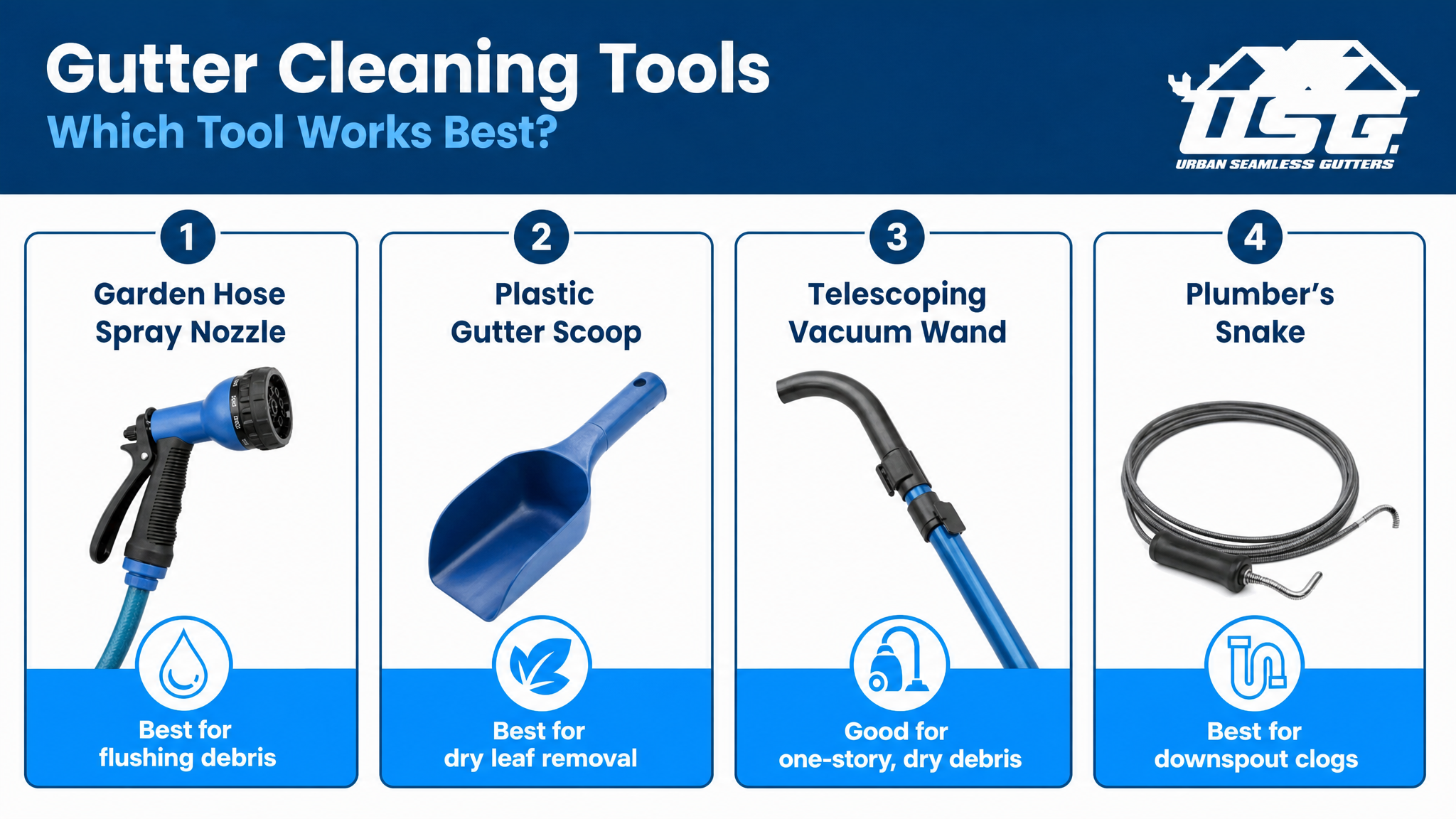
Recommended Tools or Workflows
| Tool | Best Use Case | Limitation |
|---|---|---|
| Plastic gutter scoop | Dry leaf and debris removal | Not effective on wet, compacted material |
| Garden hose with spray nozzle | Flushing debris to downspout | Requires ladder access at gutter level |
| Telescoping vacuum wand | Light debris on single-story homes | Struggles with wet or heavy loads |
| Plumber’s snake or drain auger | Clearing downspout clogs | Limited to downspout diameter |
| Gutter tongs / grabbers | Picking out large debris | Slow for long runs |
Each tool serves a specific step. None of them works well as the only tool in your kit. A complete cleaning gutter tool setup pairs at least a scoop, a hose nozzle, and a downspout-clearing option.
Real-World Examples
A homeowner in Clifton Park dealing with repeated basement dampness eventually traced the problem to a blocked rear downspout that had been missed during every annual cleaning. The trough looked clean. The problem was invisible until someone flushed the system properly.
This scenario is common, particularly on homes with rear gutters that aren’t visible from the street.
Homes near the Albany Pine Bush face a specific challenge: pine needles accumulate throughout the season and mat together densely, resisting standard scoops. For those properties, gutter cleaning services from a professional crew with proper wet-vac equipment make a measurable difference compared to a standard DIY session.
Comparison and Decision Guide
When to Choose Each Approach
| Situation | Recommended Approach |
|---|---|
| Single-story home, light debris, dry conditions | DIY with scoop and garden hose |
| Two-story or steep-pitch roof | Professional cleaning for safety |
| Heavy debris, wet compacted leaves, or pine needles | Professional or high-capacity wet vac |
| Repeated clogging despite regular cleaning | Gutter guard evaluation |
| Visible gutter sag, leaks, or separated seams | Professional inspection and repair |
Cost, Effort, and Timeline Tradeoffs
DIY gutter cleaning costs you time and carries ladder fall risk, which is the most serious factor to weigh honestly. According to the Consumer Product Safety Commission, ladders are involved in a significant share of home improvement injuries each year. Professional cleaning typically runs a predictable flat rate per visit and includes downspout clearing, minor sealant touch-ups, and a system check that most DIY sessions skip.
Gutter guards reduce cleaning frequency but don’t eliminate it entirely. Micromesh guards, which filter out fine debris including pine needles and roof grit, perform best in Capital Region conditions. Even guarded gutters benefit from a professional check every year or two, especially after severe storms.
Conclusion and Next Steps
Main Points to Remember
Getting gutter cleaning right comes down to sequence, complete system checks, and honest tool selection. Skipping the downspout, using the wrong pressure, or cleaning on the wrong schedule creates damage that costs far more to fix than a routine cleaning would have cost to do correctly.
What to Do Next
If your gutters haven’t been cleaned since last fall, or if you’ve noticed water streaking on your fascia, standing water in your troughs, or soft spots near your foundation, now is the right time to act.
Urban Seamless Gutters serves Albany, Schenectady, Clifton Park, Saratoga Springs, and the surrounding Capital Region with professional gutter cleaning, repair, and installation. Get a free quote today and find out what a properly cleaned and inspected gutter system can do for your home’s long-term protection.
Frequently Asked Questions
How often should gutter cleaning happen in Albany, NY?
Most homes in Albany and the Capital Region need gutter cleaning at least twice a year: once in late November after leaf fall ends, and once in early April after winter debris settles. Homes near heavy tree cover, particularly oak, maple, or pine, may need a third cleaning in midsummer when seed pods and early needle drop accumulate.
Skipping even one seasonal cleaning in this region creates real risk. The freeze-thaw cycle between November and March turns trapped debris into ice that expands against your gutter hangers and fascia, causing damage that outlasts the season.
What is the best cleaning gutter tool for a DIY homeowner?
The most practical starting kit includes a plastic gutter scoop, a garden hose with a firm-stream spray nozzle, and a plumber’s snake or downspout flush nozzle for clearing blockages. These three tools cover the full sequence: dry removal, flushing, and downspout clearing.
Telescoping vacuum wand systems work well on single-story homes with dry, light debris, but they struggle with wet compacted material. If your gutters collect pine needles or are routinely full of wet leaf mat, hands-on removal at gutter level is more reliable.
Is pressure washing gutters a good idea?
In most cases, no. A pressure washer set too high can force water under roof shingles at the back edge of the gutter, break down sealant at seams and end caps, and drive debris into the downspout rather than clearing it. The damage often isn’t visible immediately, which is why the mistake gets repeated.
A firm garden hose stream handles the flushing step safely and effectively for most residential gutters. If you’re dealing with stubborn buildup, a professional crew with appropriate low-pressure wet-vac equipment is a better call than escalating to high pressure yourself.
When does DIY gutter cleaning become a safety risk?
Ladder falls are the primary concern. Any gutter work above a single story, on a steep-pitch roof, or on uneven ground near landscaping, air conditioning units, or basement stairwells carries meaningful fall risk.
Two-story homes, dormers, and any roofline with limited flat ground below it are situations where professional cleaning is genuinely the safer choice, not just the easier one. If you’re unsure whether your setup is manageable solo, it probably isn’t.
How do gutter guards affect cleaning frequency?
Micromesh gutter guards reduce cleaning frequency significantly by blocking leaves, pine needles, and roof grit from entering the trough. Most well-installed guard systems cut cleaning visits from twice or more per year down to an annual professional check.
That said, guards don’t eliminate maintenance entirely. Fine debris can accumulate on top of the mesh surface, and downspouts still need occasional flushing. Our gutter guard installation guide for Capital Region homeowners explains which guard types hold up best through upstate New York winters and which ones tend to fail under ice load.
What signs mean my gutters need professional repair, not just cleaning?
Cleaning won’t fix structural problems. Watch for sagging gutter sections, visible gaps between the gutter and fascia board, rust staining or holes in the trough, or water dripping behind the gutter during rain rather than flowing to the downspout.
 Ready for a free quote? Share a few details with Urban Seamless Gutters, we’ll help you choose the right next step. Get a Free Quote |