



Key Takeaways
- Seamless gutters eliminate the seam joints where most gutter leaks begin, which is the single biggest structural advantage over sectional systems.
- Improper installation and deferred maintenance are the two most common reasons seamless gutters underperform their potential.
- The leak-reduction benefit only holds when gutters are kept clear and pitched correctly toward downspouts.
- Gutter guards, particularly micromesh designs, pair well with seamless gutters to extend cleaning intervals and reduce debris buildup.
- Understanding total cost, material options, and maintenance needs helps you make a smarter long-term investment.
Why Seamless Gutters Reduce Leaks Matters Now
Capital Region winters are not kind to gutters. Freeze-thaw cycles, heavy snowmelt, and fall downpours all push gutter systems hard, and sectional gutters with glued or snapped joints tend to fail first.
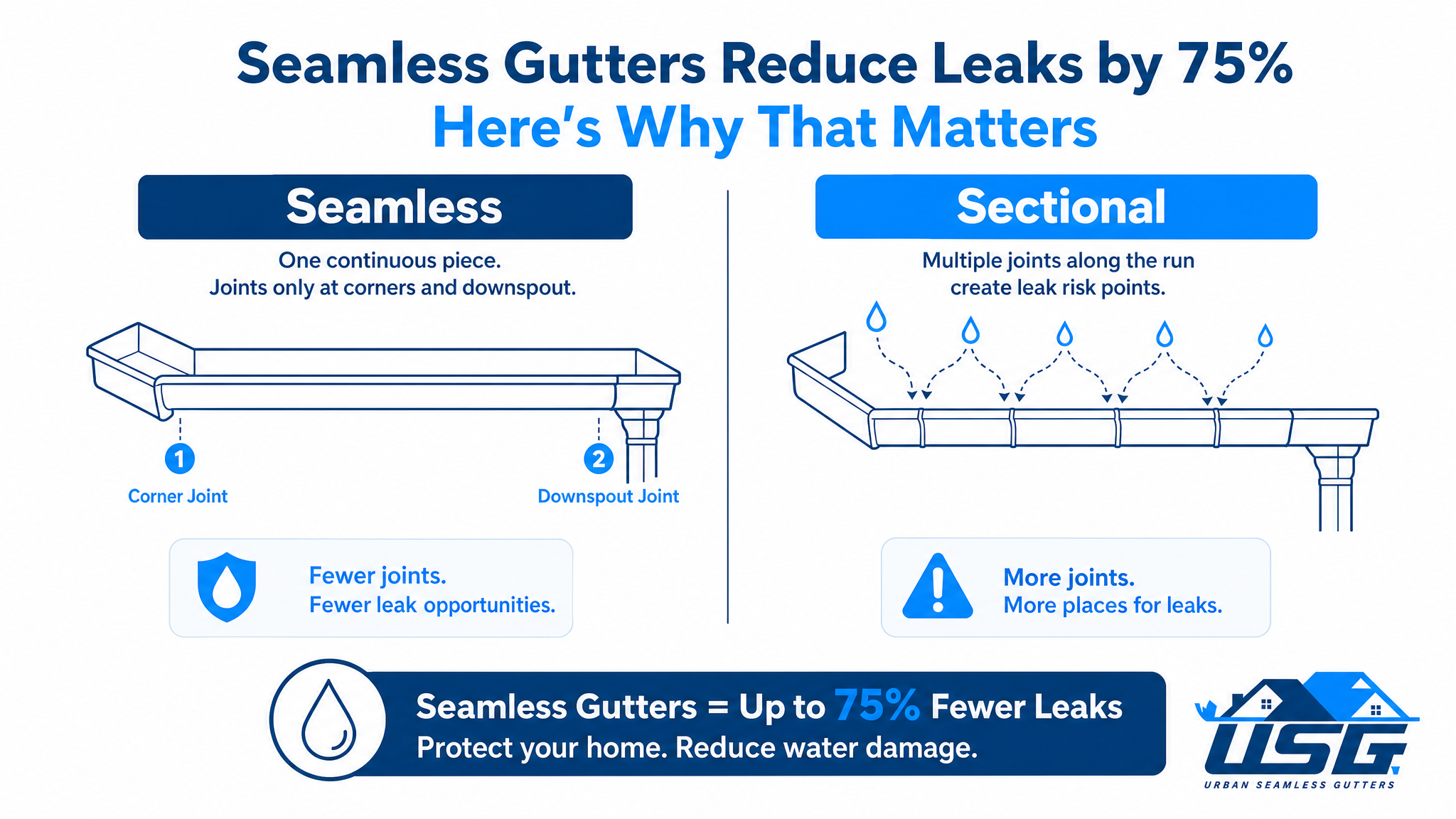
Seamless gutters are fabricated in one continuous piece from fascia corner to downspout, eliminating the mid-run joints that account for the large majority of gutter leaks in traditional sectional systems.
What Has Changed Recently
Aluminum coil stock is now available in a wider range of gauges and factory-baked colors, which means a custom-formed seamless gutter can match your trim precisely without extra finishing steps. Portable seamless gutter machines allow installers to form gutters on-site to the exact length of each run, so there’s no splicing two 20-foot pieces together in the middle of a 35-foot eave.
The popularity of micromesh gutter guards has also grown significantly. Pairing a seamless system with a quality guard means far less debris accumulation and fewer service calls over the gutter’s lifespan.
What Readers Need to Understand First
Seamless gutters still have joints at corners and downspout connections. Those points require sealant and periodic inspection. The leak-reduction advantage comes from removing mid-run seams, which are the locations most likely to separate, crack, or pull apart under ice weight or thermal expansion.
Understanding this distinction matters because some homeowners expect zero maintenance after installation. The reality is that seamless gutters are dramatically lower maintenance, but not maintenance-free. Regular gutter cleaning services are still part of the long-term protection plan.
Common Seamless Gutters Reduce Leaks Mistakes to Avoid
Even a perfectly formed seamless gutter system can fail if common installation or maintenance errors go uncorrected. Here are the two mistakes that cost homeowners the most.
Mistake 1 and How It Hurts Results
The first mistake is incorrect pitch. Seamless gutters need a slight slope, typically around 1/4 inch of drop per 10 linear feet, toward the downspout so water drains freely rather than pooling. When installers set gutters level or with a reverse pitch, standing water accumulates.
Over time that water overflows during rain events and, in winter, turns into ice dams that pry fascia boards loose and stress the corner joints.
A gutter running flat across a 40-foot eave can hold several gallons of standing water after a storm. That weight stresses hangers, causes sagging, and eventually creates exactly the kind of leak the seamless design was supposed to prevent.
Mistake 2 and How to Spot It Early
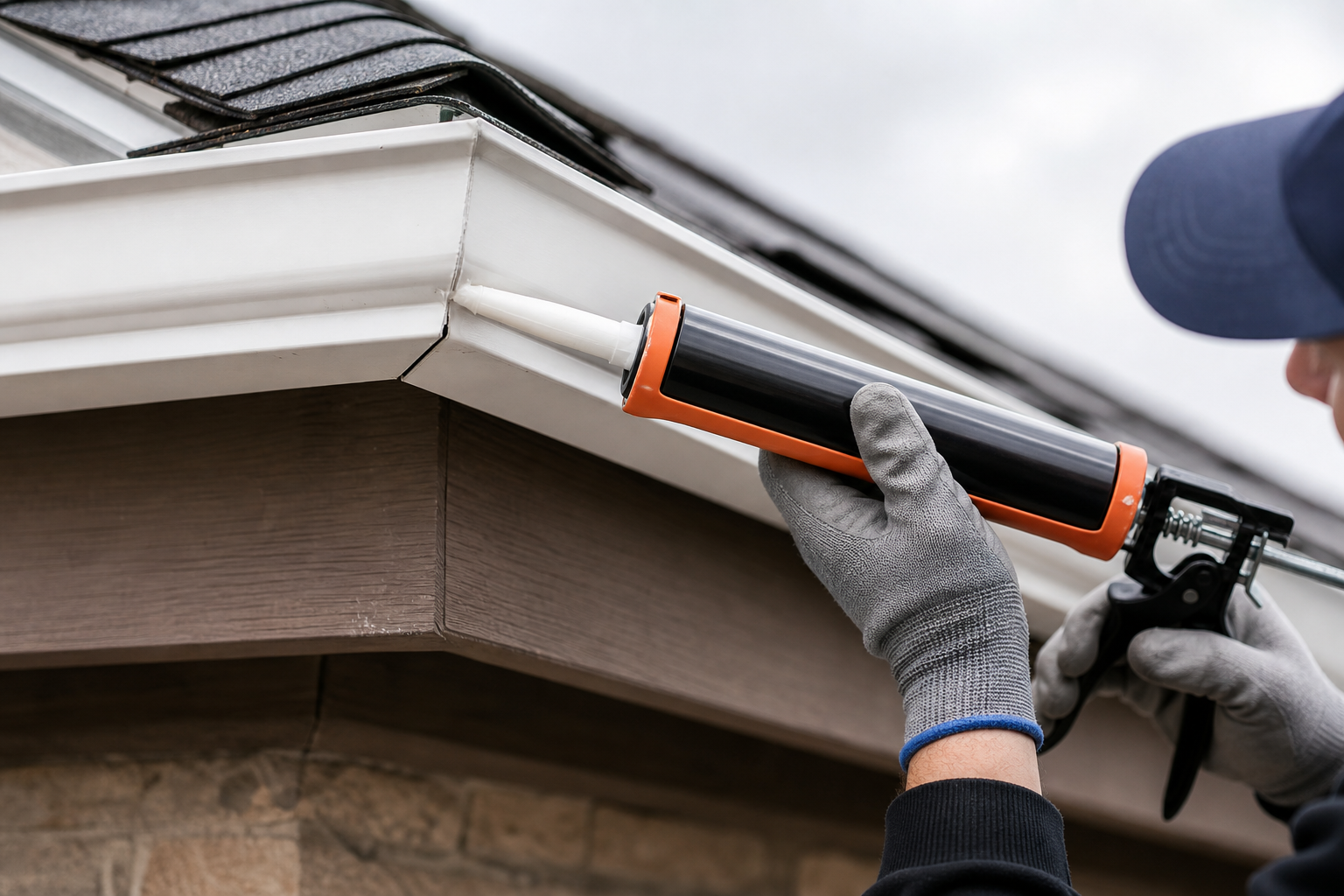
The second mistake is neglecting sealant at corner miters and downspout outlets. These are the only true joint points in a seamless system, and they need a quality butyl or silicone sealant applied during installation. If a contractor skips this step, or uses a low-grade caulk, you’ll see drips at the corners within the first heavy rain season.
You can spot this early by running a garden hose along the roofline and watching corner joints for seeping or dripping. Catching it in the first season is a quick fix: clean the joint, dry it thoroughly, and apply fresh gutter sealant. Waiting two or three years means the joint may have corroded or pulled apart enough to require professional gutter repair rather than a simple reseal.
How to Fix Each Mistake Quickly
For pitch problems, a contractor can re-pitch the gutter run by adjusting hanger positions without replacing the gutter itself, provided the fascia is still in good condition. For sealant failures, the fix is straightforward: dry the joint area, apply a butyl rubber gutter sealant rated for exterior aluminum, and allow it to cure fully before the next rain. Neither fix is expensive when caught early.
Both become expensive when ignored.
Practical Seamless Gutters Reduce Leaks Improvements
If your current gutters are older sectional gutters, or seamless gutters that are underperforming, there’s a clear path to getting more out of your system.
Audit Your Current Approach
Start by walking your roofline after a rainstorm and looking for water spilling over the front edge of gutters. That’s almost always a sign of clogged downspouts, incorrect pitch, or gutters that have pulled away from the fascia. Check corners and downspout connections for rust stains or water streaks on the siding below, which indicate sealant failure.
For a complete picture, consider scheduling a professional gutter inspection to determine whether your gutters need repair, cleaning, or full replacement. Knowing what you’re working with saves you from guessing.
Implement the Highest-Impact Fixes
Cleaning comes first. A clogged gutter defeats every other improvement you make. After clearing debris, address any sealant failures at joints and corners.
Then reassess pitch by checking for standing water 30 minutes after rainfall stops.
If the system is older than 20 years, is sectional, or is visibly pulling away from the fascia, replacement is often more cost-effective than repeated repairs. New seamless gutter installation gives you a clean baseline with no inherited problems.
Track and Refine Over Time
Keep a simple log of when you last cleaned gutters, whether you noticed overflow during storms, and when sealant was last refreshed at joints. For most Albany-area homes, two cleanings per year (spring and late fall after leaves drop) is the practical minimum. Homes under heavy tree canopy may need a third cleaning in summer.
Adding gutter guards after a fresh installation is one of the highest-impact refinements you can make. The gutter guard installation guide for Capital Region homeowners walks through your options in detail.
Tools, Examples, and Proof Points
Recommended Tools or Workflows
For DIY maintenance between professional visits, a few practical tools make the job easier:
- Gutter scoop or garden trowel for clearing wet debris
- Garden hose with adjustable nozzle for flushing downspouts
- Non-contact voltage tester before working near any roof-mounted electrical components
- Butyl rubber gutter sealant for corner and outlet touch-ups
- Gutter hanger screws to resecure any hangers that have backed out over the winter
For installation and anything beyond surface-level maintenance, professional crews with on-site seamless gutter machines produce far more consistent results than DIY approaches.
Real-World Examples
Consider a home in Cohoes with a long rear eave spanning nearly 50 feet. With sectional gutters, that run required three or four pieces joined together, meaning three or four potential leak points exposed to heavy snowmelt every February. After switching to seamless gutters, the only joints are at the two corners and the single downspout connection.
That’s a meaningful reduction in leak risk concentrated on a single long run that previously caused recurring basement moisture issues every spring.
In Clifton Park, where pine trees are common, homeowners frequently deal with needle buildup that sectional gutter joints trap and accelerate rusting. Micromesh guards over seamless gutters solve both problems at once, keeping needles out while eliminating the joints where debris-driven moisture accelerates corrosion.
Comparison and Decision Guide
When to Choose Each Approach
| Situation | Best Option | Reason |
|---|---|---|
| New construction or full reroofing | Seamless gutters | Clean install, no inherited joint problems |
| Older sectional gutters leaking at seams | Seamless replacement | Eliminates root cause of leaks |
| Seamless gutters with one failing joint | Spot repair + reseal | Cost-effective if system is otherwise sound |
| Heavy tree coverage, frequent clogs | Seamless + micromesh guards | Reduces cleaning frequency, protects joints |
| Tight short-term budget | Sectional repair as bridge | Buys time, but plan for replacement within 5 years |
Cost, Effort, and Timeline Tradeoffs
Understanding the cost for seamless gutter installation helps you plan accurately. Seamless aluminum gutters typically cost more upfront than replacing with sectional gutters from a home center, but the labor savings over time are significant. Fewer repairs, longer intervals between maintenance calls, and better water management add up quickly.
| Factor | Seamless Gutters | Sectional Gutters |
|---|---|---|
| Leak risk points | Corners and downspouts only | Every joint (every 10, 12 ft) |
| Typical lifespan (aluminum) | 20+ years | 15, 20 years |
| Maintenance frequency | Lower | Higher |
| Custom fit | Yes (formed on-site) | No (pre-cut lengths) |
| Install cost | Moderate to higher | Lower upfront |
| Long-term value | Better | Lower |
For detailed local pricing guidance, the average cost of gutter installation page breaks down what factors affect your final number in the Capital Region.
Conclusion and Next Steps
Main Points to Remember
Seamless gutters reduce leaks primarily by eliminating the mid-run seam joints that account for most gutter failures. The benefit is real and substantial, but it only holds when the system isinstalled correctly, maintained consistently, and supported by quality sealant at the remaining connection points. Correct pitch, proper hanger spacing, and clear downspouts are what keep the leak-reduction advantage intact over the life of the system.
Skipping any one of those elements, whether it’s a deferred cleaning or a corner joint that was never sealed properly, erodes the performance gap between seamless and sectional gutters over time.
What to Do Next
Start with a visual inspection after the next rainstorm. Look for overflow, drips at corners, or water staining on siding. If you see any of those signs, the problem is fixable, but acting sooner saves you from more serious repair costs later.
If your gutters are aging sectional gutters or a seamless system that’s consistently causing trouble, get a professional assessment before another Capital Region winter arrives. Urban Seamless Gutters offers free estimates across Albany, Schenectady, Clifton Park, Saratoga Springs, and Cohoes. You can also explore your full range of options through our seamless gutter installation service page to understand what a new system involves from start to finish.
Frequently Asked Questions
How much do seamless gutters reduce leaks compared to sectional gutters?
Seamless gutters eliminate mid-run joints entirely, which is where the large majority of gutter leaks originate in traditional sectional systems. The only remaining connection points are corners and downspout outlets, both of which are sealed during installation. The practical result is far fewer leak events over the system’s lifetime, particularly during heavy Capital Region rainstorms and spring snowmelt.
The exact performance difference depends on installation quality, maintenance habits, and the materials used, but the structural advantage is consistent: fewer joints means fewer places for water to escape.
Are seamless gutters worth the higher upfront cost?
For most homeowners in Albany, Saratoga Springs, and surrounding areas, the answer is yes. The higher upfront cost is offset by lower maintenance frequency, fewer repairs, and a longer effective lifespan compared to sectional gutters. When you factor in the cost of recurring sealant repairs on sectional systems and the labor involved in frequent cleaning around joint debris traps, seamless gutters typically deliver better total value over a 10-to-20-year window.
The average cost of gutter installation varies by linear footage, material gauge, and home profile, so a free estimate gives you the most accurate number for your specific situation.
Do seamless gutters still need regular cleaning?
Yes. Seamless gutters reduce leaks dramatically, but they still collect leaves, pine needles, seed pods, and roof granules over time. A clogged seamless gutter will overflow just as readily as a clogged sectional one.
Most Capital Region homes need at least two cleanings per year, typically in spring after tree bloom and in late fall after the last leaves drop.
Homes surrounded by mature trees, particularly pine and oak, often need a third cleaning in late summer. Adding micromesh gutter guards after installation is the most effective way to extend the interval between cleanings without sacrificing protection.
Can I install seamless gutters myself?
Seamless gutters require a portable roll-forming machine to fabricate continuous runs on-site. These machines are not available at home improvement stores and are not practical for a single-home DIY project. The installation also involves precise pitch setting, hanger placement at correct intervals, and sealed corner miter cuts that require experience to get right the first time.
Attempting DIY seamless gutter installation typically results in pitch errors and joint failures that negate the system’s core advantage. Professional installation from a qualified gutter contractor is the reliable path to getting the full leak-reduction benefit.
How do I know if my current gutters need repair or full replacement?
The clearest signs that repair is no longer enough include: gutters pulling away from the fascia along multiple sections, visible rust or holes in the gutter channel, persistent overflow despite recent cleaning, and water staining on the foundation or basement walls below the roofline. If you’re seeing two or more of those symptoms, replacement is usually the smarter investment.
Single-point failures, like one leaking corner or a loose hanger, are good candidates for repair. For a clear decision framework, the guide on when to repair, clean, add guards, or replace seamless gutters walks through the decision in plain terms. When in doubt, a professional inspection takes the guesswork out of it.
What material is best for seamless gutters in the Capital Region?
Aluminum is the most practical choice for most Capital Region homeowners. It resists rust, handles freeze-thaw cycles well, accepts factory-baked paint finishes that hold color for years, and is available in a wide range of gauges. Heavier gauge aluminum (.032 inch or thicker) holds its shape better under snow load and ice, which matters considerably in Albany-area winters.
Copper gutters offer a longer lifespan and distinctive appearance but come at a significantly higher cost. Steel gutters are durable but prone to rust at cut ends and fastener points. For most residential applications, aluminum seamless gutters hit the right balance of performance, longevity, and cost.
 Ready for a free quote? Share a few details with Urban Seamless Gutters, we’ll help you choose the right next step. Get a Free Quote |